 "It is easier for a camel to go through the eye of a needle than for a rich man to enter the kingdom of God."
The phrase, "camel through an eye of a needle," is not exactly typical of our language today. This saying comes from the story of the rich man/ruler asking Jesus what else he must do to inherit eternal life - as is written in 3 narratives: Luke 18:18-30, Mark 10:17-31, Matthew 19: 16-30. In the attempt to understand what Jesus means, there have been a few popular interpretations. Kneeling under the Camel Gate. One of the most common explanations I've heard in church, is that Jesus is referring to a small gate or low entrance into Jerusalem, known as the Camel Gate. The lesson is that the camel can pass through the gate if it kneels down and crawls through. Therefore the rich man can likewise get into heaven if he humbly kneels before God. There is at least a possibility that the rich man can get into heaven. This is all fine and dandy and probably a harmless interpretation, but there's some serious problems. First, it misses most of Jesus' point (which we'll get to). Second, there is no Camel Gate - or at least it has never been found. The Roman ruins of Jerusalem have been well studied by archaeologists and there are several grandiose Roman gates/entrances. All of them would easily fit the tallest of all camels, so why would someone take their camel through some tiny obscure "Camel Gate?"
 The Rope Interpretation. Another theory states the Aramaic word for 'camel' is the same as the word for 'rope', and that Jesus could be describing a rope (made of camel's hair) passing through a larger wooden needle (used for 1st century industrial projects). The point of this interpretation is, again, to create a possibility that the rich man can enter the Kingdom. A rope has a much better chance of passing through the eye of a needle than does a camel. And, for the modern reader, it lessens the 'weirdness' of the comment. Again, there are issues with this interpretation. We don't know if the gospels were ever written in Aramaic first. All of the oldest writings of the New Testament and early church fathers are in Greek and clearly say the word "camel."
The Impossiblity. This interpretation simply takes Jesus' phrase at face value; as a Jewish metaphor for describing something impossible. Jesus even explains it himself. His sentences, both preceding and following his camel comment, state "how hard it is" and that "with man this is impossible."
Its important to note Jesus' phrase, "eye of the needle," is not the only ancient instance of this expression. The Talmud uses the phase similarly to connote an impossible situation. Instead of a camel, it mentions an "elephant passing through an eye of a needle" as being analogous to seeing a "palm made of gold." In 2 other instances, the Talmud uses this metaphor to make very strong points. It was common for them to use exaggerated language, or hyperbole, and paradoxes to teach a lesson. Of course, Jesus also loved to use hyperbole to make his points (i.e. 'remove the plank in your eye', 'cut off your right hand' and 'gouge out your eyes if they cause you to sin', 'hate your father and mother if you are to be a disciple', etc).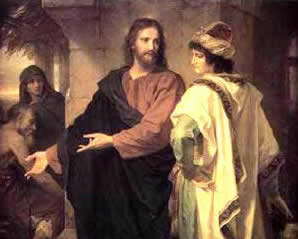 Concerning the Rich Ruler, Jesus uses this verbal technique to astonish his disciples. They "were amazed" at such talk and they asked,"who then can be saved?" In the Jewish culture of the time, Jesus was making an inconceivable and radically deep statement. While making a point about riches and the nature of the Kingdom of Heaven, He was also attacking the entire Jewish religious system and culture as a whole. The understanding of the Jews of the time was that the rich people are blessed because they do the right thing and follow all the commandments. They are godly and "good," and therefore blessed with wealth. As a result, the rich took great pride in their exalted status. Salvation was guaranteed. The poor, on the other hand, suffer because they sinned or their parents sinned in the past (i.e. see blind man story in John 9:2). Jesus did not agree. Just as He often lashed out against the respected religious leaders for "straining out gnats but swallowing a camel" (another hyperbole), he attacks the concept of the rich having an automatic get-into-heaven card. Despite the prevailing cultural thought, Jesus makes it clear that they are NOT saved by their good works, wisdom, or wealth.
The Rich Ruler started the whole discussion by asking what he can DO to inherit eternal life. Before shocking the crowd with his answer, Jesus first responds by giving him a lesson on who is "good". Nothing you do makes you good, only God is good. To test his heart, Jesus gave him one difficult option: to essentially to give up his life completely, his rule and his wealth, and to then follow Him. To the rich man, the option was equivalent to 'passing a camel through the eye of a needle,' and he just couldn't do it. He was not WILLING to give it all up. Most likely it was his pride, but Jesus is looking for a humble heart before God.
So who then can be saved?
Fortunately for the Rich Ruler, the book of Mark says that "Jesus looked at him and loved him." So who knows what ultimately happened to the man. Jesus said, "with man this is impossible, but not with God; all things are possible with God." A reliance on riches, or the knowledge and wisdom used to gain them, or on following commandments and doing good works does not get you into the Kingdom of Heaven. A rich man entering the Kingdom of Heaven is impossible WITHOUT God. The wealth itself is not bad, but all of our worship and reliance must be on God who changes and humbles men's hearts. So, good news for the faithful rich people like Joseph of Arimathea, Lydia, Abraham, and Melchizedek!
Top photo is from Bible Picture Gallery.
2nd painting by Christian Dare Art .
Friday, October 19, 2007
A Camel in the Eye of a Needle

Subscribe to:
Post Comments (Atom)





12 comments:
The Greek words for "camel" and "rope" differ by one letter: Kamelon vs Kamilon (you can change the font to "symbol" to see what those look like in Greek.) All of the oldest manuscripts have "camel".
Yes, thanks for the correction. They are not the same, just very similar.
Any way you interpret this passage, the message Christ challenges every man and woman up to this day with is this: IF YOU ARE NOT WILLING TO LEAVE EVERYTHING BEHIND TO FOLLOW ME...YOU ARE NOT WORTHY OF ENTERING THE KINGDOM OF HEAVEN. Christ touched on this same theme when he said he did not COME INTO THE WORLD TO BRING PEACE, BUT TO SEPERATE MOTHER FROM DAUGHTER, AND TURN SON AGAINST FATHER, AND HUSBAND AGAINST WIFE ETC. ETC.
The ultimate message is clear,..AND IT IS VERY HARD TEACHING for some...who deep down have their treasures stored up here on this earth in everything from their grandchild to their profession to their savings account and their sex life...CHRIST REPEATEDLY EMPHASIZED THE SAME THEME: HE WHO FINDS HIS LIFE WILL LOSE IT, AND HE WHO LOSES HIS LIFE...WILL FIND IT...meaning...when you've lost or given up EVERYTHING you love in your heart about this wicked, temporary, passing world...YOU ARE TRULY ON THE RIGHT PATH. Until each of us is prepared to sacrafice absolutely ALL for our Christianity...we have much to work on.
I'm facing a seeming dillema about wealth. I've got an opporunity to control an inhertiance of seven figures. That's pretty much wealth by anyone standards. Not being in control of it all myself is like being a servant instead of a master. I can see that its a Biblical principle that heirs are not to remain as mere servants all thier life ( Gal 4 ) and that if a man can be made free, he should get free. ( 1 Cor 7:21 ). Its definately a good and natural thing to enjoy being on top instead being a servant instead of a lord. Yet, the Bible also speaks of discipleship with radical measures of faith, obedience and sacrifice. The rich young ruler is tied up with man's ways and things. But God has made it clear that you cannot serve two masters. It is also written than no man that warreth entangleth himself with the affairs of this life ( 2 Tim 2:4 ). So the decision for me to not take control over an inheritance was the decision not to get entangled in the everdemanding requirements of wealth issues, like tax, investments, laws, and the like. It sounds so promising to labour for God's redemptive purposes in the world of poverty and suffering ( not to mention your own christian friends ) but the true way is the Lord's way of the cross - that His Spirit will affect the world. As Paul's example: I count all but dung that I may know Him and the power of his resurrection. If we dont know Him intimately, how can we do anything for God? And the cost of knowing Him like a true disciple is worth everything. God is God of heaven and earth, he doesn't need our pitiful offerings of gold and silver for his purposes. He has alwyas used human instruments. The one great need of the church always has been and always will be the great Holy Ghost.
! amen.
Hi Anonymous, Thanks for sharing your thoughts on the wealth dilemma... enjoyed reading about your decision and comments.
you should not comment, you don't know what you talking about. wealth is evil, money is evil... real wealth is in our soul, in heaven. jesus sais it many times but you are commenting according to your hearth. cleanse you hearth first.
How can one cleanse ones own heart? Out of the heart produces every kind of evil. Why would a heart that is evil even want cleansing? Would it not desire the evil that it is?
Money is not evil – the LOVE of money is. When money becomes a god it produces all kinds of evil attain and maintain it. Money is simple a tool or means that God allows us to us for His greater good. To support His on-going work of Kingdom building; proclaiming His message of repentance and belief, strengthening those of the faith, and helping others in need – their greatest need to know that their sin no longer belongs to them but to Christ and in its place they receive His righteousness. Which brings us back to a clean heart – “create in me a clean heart O God” and He does through the blood that covers all your sins. Forgiven in the name of the Father, Son and Holy Spirit. – a clean heart cleansed by a Savior who is not you.
www.godmammon.com is very informative. The article is very professionally written. I enjoy reading www.godmammon.com every day.
instant cash loans
pay day loans
I inherited a large sum of money a few years ago, and asked myself what can I do with each dollar that is to the glory of God? Buy ever more expensive houses and cars? I prayed on this, and was answered by the Holy Spirit. I have given away nearly all of it to non-profit organisations working to end the suffering of our brothers and sisters throughout the world as I am commanded by the testament of our Lord and Saviour, and am at a loss to understand how any Christian in a position of wealth could do otherwise. The rest it's in trust for the education of my son so that he might fulfil his God-given potential to make the world a better place as a doctor. Read the Book, people, the choices are clear!
I really enjoyed reading this post. I have a friend right now who's main focus is getting wealth. It's sad that he has people in his ear that are about getting money By any mean necessary.
It's the worst feeling in the world seeing your friends go down the wrong path headed to destruction.
Hi,
Who can I speak to regarding advertising today?
Thanks,
Gary
gary@socialreality.com
Michael Idarecis claims spiritually this passage is highlighting the ego of man which contrasts the Reign of God. The "eye" is the "I" of a rich man's inflated ego. The rich man has an enormous "I", we also see earlier in verse 16 the rich man wanted to stand upon his own will to enter into the reign of the heavens. Whereas the camel being an unclean animal is synonymous to a regular person with an "I" so small that it is the size of a needle. Therefore the eye ("I") of a needle is easier to enter into the reign of the heavens" over the "I" of the rich man.
Post a Comment